Overview
ACL reconstruction replaces the torn anterior cruciate ligament with a tendon graft anchored in tunnels drilled through the femur and tibia, so the knee stops sliding and rotating when an athlete plants, cuts or lands. A well-placed graft rehabilitated on criteria gives a stable knee that returns to pivoting sport and protects the meniscus and cartilage from the damage repeated giving-way causes.
Dr. O'Donnell performs ACL reconstruction arthroscopically as an outpatient at Bayside Surgery Center, most often with a quadriceps tendon autograft, and repairs any meniscus tear at the same operation.
Who It's For
Reconstruction is recommended for athletes who intend to return to cutting and pivoting sports, for anyone whose knee gives way with daily activity, and for patients with a repairable meniscus tear alongside the ACL tear, because a meniscus repair does not hold in an unstable knee. Age matters less than activity, though open growth plates change the technique in younger patients.
Patients whose sport and work are straight-ahead, with no meniscus tear to protect and no giving way, can do well with rehabilitation alone, provided they genuinely stay out of pivoting sport.
An MRI showing an ACL tear does not by itself mean the knee must be reconstructed. Dr. O'Donnell recommends the operation when the Lachman and pivot-shift tests confirm instability, the history fits, and the patient's sport or daily life requires a stable knee; some patients do well with rehabilitation alone. The ACL tear page explains how the finding is assessed.
What the Procedure Involves
The graft decision is made together before surgery. Quadriceps tendon autograft, a strip of the tendon above the kneecap, is Dr. O'Donnell's usual choice for athletes: a thick, strong graft with a low re-tear rate and less kneeling pain than a patellar tendon harvest. Bone–patellar tendon–bone autograft, the middle third of the patellar tendon with bone at each end, remains the reference standard for high-demand contact athletes because bone heals to bone quickly in the tunnels; its cost is more anterior knee pain. Allograft, donor tendon, avoids a harvest site and suits patients over about 35 or with lower-demand goals, but it incorporates more slowly and re-tears more often in young athletes.
Surgery is scheduled 2 to 6 weeks after injury, once swelling has settled and straightens fully. Under a nerve block plus general anesthesia, the graft is harvested through a short incision while the arthroscope is used to inspect the knee, treat meniscus and cartilage injuries, and clear the torn ligament. Tunnels are drilled at the ACL's anatomic attachment points on the femur and tibia, the graft is pulled through, tensioned near full extension and fixed at both ends with a suspensory button or interference screw. The operation takes about 90 minutes, longer when a meniscus is repaired.
Risks & How They Are Minimized
Graft re-tear is the risk that matters most and is driven by graft type, tunnel position and returning too early. Dr. O'Donnell uses autograft in young athletes, places the tunnels anatomically, and holds return to sport to test criteria rather than a date, since re-injury roughly doubles for athletes who return before 9 months. Stiffness, particularly loss of full extension, is the most common complication and is prevented by operating on a quiet knee and making full extension the first rehabilitation goal. Infection is uncommon after arthroscopy and is guarded against with a pre-incision antibiotic; deep-vein thrombosis is addressed with early walking and aspirin for 14 days. Numbness on the outer shin below the harvest incision is common with patellar tendon grafts, less so with quadriceps tendon, and usually fades.
Recovery & Rehabilitation
Rehabilitation is the longest part of treatment and the part that decides the result. The protocol restores full extension and quadriceps control first, then rebuilds strength on criteria rather than elapsed time. Two rules run through the first 6 to 12 weeks: keep full passive extension, and avoid resisted open-chain knee extension in the last 40°, which loads the graft more than anything else in the gym. The quadriceps tendon autograft protocol runs as follows.
| Phase | Timing | What happens |
|---|---|---|
| Protection & motion | Weeks 0–2 | Brace locked in extension for walking, crutches, weight bearing as tolerated. Quad sets, straight-leg raises, patellar mobilizations, heel slides to 90°, prone hangs for extension. Advance with full passive extension and a straight-leg raise without lag. |
| Motion & early strength | Weeks 2–6 | Flexion progressed to full; brace and crutches weaned. Mini-squats, leg press 0–60°, bridges, stationary bike, balance work, hamstring and calf strengthening. Advance with full motion, normal gait and good quad control. |
| Strengthening | Weeks 6–12 | Progressive closed-chain strengthening; open-chain quad work in protected ranges as cleared. Elliptical, bike and pool conditioning, core and hip work. Advance at 70% quad strength with no swelling. |
| Running & agility | Months 3–5 | Criteria-based running progression, double- then single-leg plyometrics, agility and change-of-direction drills. Advance at 80% quad strength and symmetric hop testing. |
| Return to sport | Months 6–9 | Full plyometric and agility program, sport-specific drills and controlled scrimmage. Cleared at a Limb Symmetry Index of 90% or better on strength and hop testing. |
The bone–patellar tendon–bone protocol follows the same phases and timing with added attention to the donor site: anterior knee pain is monitored, patellar mobility is worked from the first week, and open-chain quadriceps work is progressed more cautiously. The allograft protocol has no donor site, so early motion is more comfortable, but donor tissue incorporates more slowly, so loading is advanced more conservatively and return to sport is set at months 7 to 9. Across all three, desk work is possible within 1 to 2 weeks, driving once off crutches and out of the brace at about 4 to 6 weeks, running at 3 to 4 months, and competitive cutting sport most often at 9 months.
Protocol summary
Precautions: weight bearing as tolerated on crutches with the brace locked in extension for walking early; full passive extension as the top early priority; no active open-chain knee extension through 0–40° for the first 6 to 12 weeks; no running, cutting or pivoting until cleared by criteria. With an autograft, the donor site is protected with gentle quad re-activation.
Criteria: full passive extension and a straight-leg raise without lag end phase one; full motion and normal gait end phase two; 70% quad strength ends phase three; running advances at 80% quad strength with symmetric hop tests; return to sport requires a Limb Symmetry Index of at least 90%, no apprehension, and surgeon clearance, most often at 9 months.
Physical Therapy Protocols
ACL Reconstruction — Quadriceps Tendon Autograft PDF ↗ACL Reconstruction — Allograft PDF ↗ACL Reconstruction — Bone–Patellar Tendon–Bone PDF ↗Frequently Asked Questions
Which ACL graft has the lowest re-tear rate?
In young, high-demand athletes, the two autografts, quadriceps tendon and bone–patellar tendon–bone, have the lowest re-tear rates and are what Dr. O'Donnell uses for them. Allograft re-tears more often in patients under about 25 and is reserved for older or lower-demand patients.
How long until I can walk without crutches after ACL surgery?
Most patients are walking without crutches by 2 to 4 weeks, once they have full extension, a strong quad set and a normal gait pattern. Weight bearing is allowed from the first day, so crutches are for gait quality rather than protection.
When can I drive after ACL reconstruction?
For a right knee, once you are off crutches, out of the brace and off narcotic pain medication, and can brake hard without hesitation, usually 4 to 6 weeks. For a left knee with an automatic transmission, driving is possible sooner.
Why does return to sport take 9 months?
The graft is weakest at 6 to 12 weeks as it remodels and only gradually regains strength over the following year. Re-injury rates fall for each month return is delayed up to about 9 months, and athletes who pass strength and hop testing at 90% symmetry re-tear less often. Dr. O'Donnell clears athletes on those tests rather than on a date.
Can I have ACL surgery with Dr. O'Donnell if I live outside Florida?
Yes. Out-of-town patients start with a telemedicine consultation and upload their MRI through mymedicalimages.com, have surgery at Bayside, stay locally for the first post-operative visit, then do rehabilitation at home using Dr. O'Donnell's graft-specific protocol, with follow-up by telemedicine. See the visiting patients page.
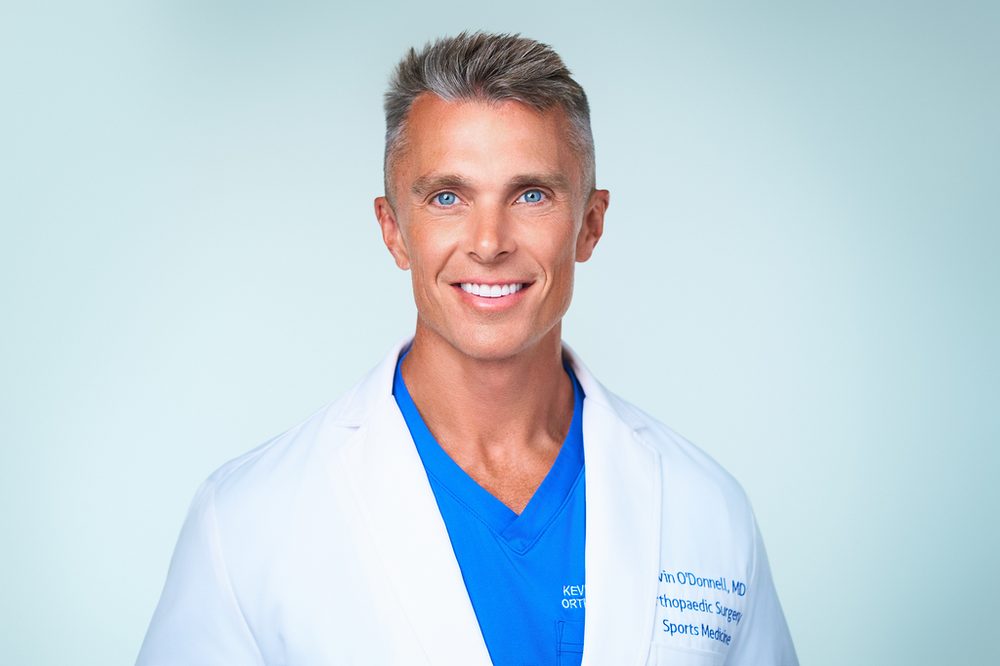
This page is for general education and is not a substitute for a medical evaluation. The right procedure depends on your individual diagnosis, anatomy, and goals. Kevin O'Donnell, MD sees patients from Coral Gables, Miami, Brickell, Pinecrest and Coconut Grove at 475 Biltmore Way, and out-of-town patients by telemedicine.